
“Violence should never be considered part of the job”
28 October 2026
Violence Against School Support Staff: Nearly 30,000 Incidents Recorded
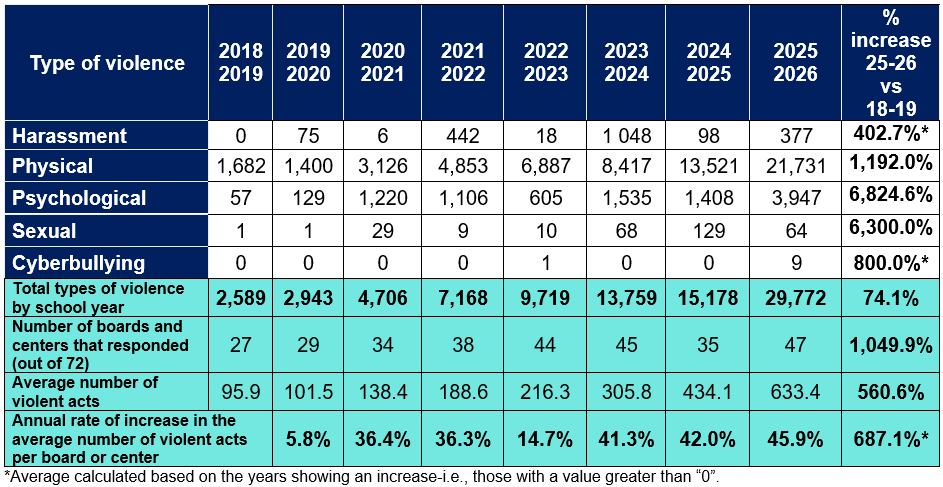
The latest data from school service centers and school boards, compiled by the School Support Staff Federation (SSSF-CSQ), reveal an extremely concerning rise in acts of violence against school support staff. For the 2025–2026 year, 29,772 acts of violence were recorded, compared to 15,178 in 2024–2025. This represents increase of approximately 96% in just one year.
The trend observed over several years is equally alarming. The number of recorded incidents has climbed from 2,589 in 2018–2019 to 29,772 in 2025–2026.
“What these figures tell us is that violence is no longer a marginal phenomenon in our schools. When nearly 30,000 incidents are recorded in a single school year, we must stop trivializing the situation. Being hit, threatened, harassed, or intimidated should never be considered part of the job,” states SSSF-CSQ President Éric Pronovost.
Direct Student Support Roles Disproportionately Affected
Certain job categories are at much higher risk. Special education technicians, educators in school settings, attendants for handicapped students, and student supervisors are particularly affected by violence. Together, they accounted for 17,533 acts of violence in 2025–2026, representing 59% of all such acts reported that year.
“These are the very workers who are at the heart of the relationship with students, often working with young people who have special needs. They are asked to intervene, prevent crises, and ensure the safety of both students and school staff. But they also need to be protected, and we need to provide them with the resources, staffing levels, and conditions necessary to carry out this work safely,” adds Éric Pronovost.
Significant Increase in Acts of Violence
We have observed a very significant increase in the number of acts of violence recorded in the school environment since 2018–2019. In 2025–2026, 29,772 acts of violence were reported, compared to 2,589 in 2018–2019, an overall increase of 1,049.7%.
Physical violence remains, by far, the most frequently reported form of violence, rising from 1,682 to 21,731 cases, while psychological violence has also seen a sharp rise, jumping from 57 to 3,947 cases. Harassment, sexual violence, and cyberbullying have likewise shown marked increases over this period.
However, these data must be viewed in context, as the number of school service centers and school boards that responded increased from 27 to 47. Even when accounting for this change, the trend remains concerning: the average number of acts of violence per school service center or school board rose from 95.9 to 633.4, an increase of approximately 560%. Furthermore, in 2025–2026 alone, the total number of recorded acts surged by 45.9% compared to the previous year, illustrating a recent acceleration of the phenomenon.
Deteriorating Occupational Health
This rise in violence is occurring against a backdrop where the health of school support staff is also showing concerning signs of deterioration. According to the latest data obtained from the Ministry of Education, the number of individuals who took a leave from work, recognized by the CNESST (Commission des normes, de l’équité, de la santé et de la sécurité du travail), increased by 58.7% between 2020–2021 and 2024–2025, rising from 2,580 to 4,095. At the same time, the number of days of absence associated with these cases nearly doubled, climbing from 76,285 to 152,022 days (+99.3%).
During the same period, days of absence due to illness rose by 86.2%—from 135,666 to 252,591—while absences related to disabilities increased by 38.6%, reaching 529,548 days. These figures compound the concerns already raised by the SSSF-CSQ regarding excessive workloads, staff shortages, and the growing number of violent incidents within educational institutions.
“These data deserve a response from school authorities and the Ministry of Education. On one hand, we are seeing an explosion in acts of violence; on the other, absences linked to workplace accidents, illness, and disabilities are rising significantly.” “Behind these figures are thousands of workers who support students every day and who are increasingly reaching their breaking point. We cannot keep asking more and more of them without taking their health and safety into account,” says Éric Pronovost.
Students Are Responsible for the Vast Majority of Violent Incidents
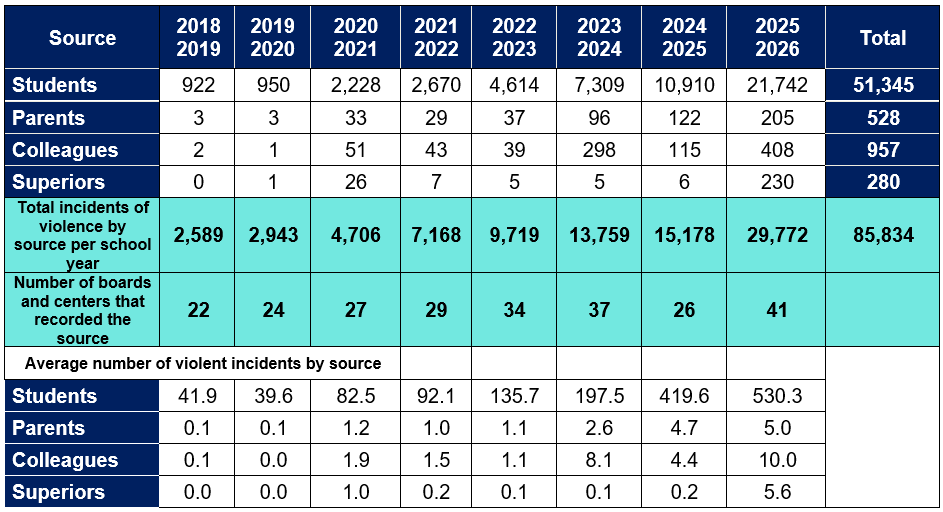
The data also sheds light on the sources of some of the reported violent incidents. In 2025–2026, 21,742 incidents were attributed to students, compared to 10,910 the previous year and 922 in 2018–2019. For that same year (2025–2026), the table also records 205 incidents involving parents, 408 involving colleagues, and 230 involving superiors.
“Behind each of these figures is a staff member who experienced a situation that should have been avoided. And behind many of the actions taken by students, there are also needs that our system should have been able to address. The solution is not to point fingers at young people. It lies in greater prevention, adequately staffed teams, prompt interventions, and environments capable of supporting both students and staff,” emphasizes Éric Pronovost.
Data that Also Calls for Greater Accountability
“If we truly want to prevent violence, we must begin by obtaining a complete and accurate picture of the situation. Quebec needs to establish standardized mechanisms to document incidents, analyze them and, most importantly, take timely action. It is far more difficult to prevent what is not adequately measured,” concludes Éric Pronovost.
The SSSF-CSQ is therefore calling for the prevention of violence against school staff to become a genuine priority across the entire education system. This must translate into concrete preventive measures, sufficient resources within schools, support for both victims and students, and a standardized mechanism for collecting data on and tracking incidents.
Survey on Violence Experienced by School Support Staff
These figures unfortunately confirm what we have observed in our own research. Our most recent survey, conducted among 4,901 SSSF-CSQ members, reveals that more than one in two individuals (56%) experienced violence at work during the 2025–2026 period. Even more concerning is that 42% of respondents view violence, in any form, as a normal or routine part of their daily work. “When violence comes to be perceived as a part of everyday life, it is clear that we must take collective action,” emphasizes Mr. Pronovost.
Reporting Violence Remains a Taboo in Many Environments
According to the same survey, only 13% of respondents state that they file an incident report when they are subjected to an act of violence. This low figure is particularly troubling. Many staff members have indicated that they choose not to report incidents because they feel it leads to no tangible change, or because they fear retaliation from their managers. For Éric Pronovost, this situation reveals the true scale of the problem: “If only 13% of victims file an incident report, then the 29,772 reported acts of violence are likely just the tip of the iceberg in terms of what school support staff actually endure. Behind these figures lies a far more concerning reality. It is high time for things to change.”
National Campaign: “Violence: It’s Up to Us to Act”
“Today, we don’t just want to denounce violence, we want it to stop. That is why we are launching the national campaign ‘Violence: It’s Up to Us to Act.’ This campaign serves as a reminder that violence must never be normalized, and it highlights a range of potential solutions. Together, we must take action, through prevention, intervention, and postvention, to ensure that school environments are healthy and safe,” concludes Éric Pronovost.
